Nigel Winterburn: Nutty Boy
Without doubt one of the most popular players Arsenal Football Club has ever seen, Nigel Winterburn was a crowd favourite for over 13 years. Despite being one of the most consistent defenders in England over that period, sadly he was a player almost constantly overlooked by international managers. Born in Nuneaton on December 11th 1963, it was scandalous that he was only capped three times by his country, despite his outstandingly consistent form throughout his Arsenal career. This was in no small part down to the form of the imperious Stuart Pearce, who ironically is currently a team-mate of Winterburn's at West Ham United.
Having begun his professional career with Birmingham and then moving to Oxford, Winterburn signed on as part of the then-embryonic "Crazy Gang" of Wimbledon prior to the 1983-84 season. Whilst there he created a Wimbledon club record by winning their Player Of The Year for 4 consecutive seasons - the only four seasons he actually spent there. In May 1987, in a move touted by many as the catalyst for Dave Bassett's resignation from Wimbledon, Arsenal manager George Graham bought Winterburn for the bargain sum of 350,000 pounds. In the 13 years that followed, he would go on to join the likes of O'Leary, Adams and Armstrong as one of the top 4 Arsenal players in terms of appearances for the club, and make the Number 3 shirt his own.
His debut was a somewhat inauspicious one, and in no way a sign of the successes to come - a 1-0 defeat against Southampton at Highbury in November 1987. Initially he began his Arsenal career out of position as a right-back following the transfer of Viv Anderson to Manchester United. This was before Graham put the finishing touches to what would become the greatest defensive unit the English game has ever seen, with his purchases of Lee Dixon and Steve Bould from Stoke City the following year.
The incumbent left-back in 1987 was England international Kenny Sansom, who played just under 400 games for The Gunners. With the purchase of Dixon, Winterburn was moved across to his more natural left-sided berth, and Sansom departed. One of the biggest tributes that one could say about Winterburn could be that this potentially difficult period of transition in the left-back berth was almost non-existent.
Now in his rightful position, Winterburn's contributions to Arsenal's success during the Graham era and beyond were immeasurable. His first season at Highbury garnered him a Littlewoods Cup (League Cup) Winners' medal following a 2-1 win over Liverpool. But there would be more to come. Graham had created a team built on the premise of defence-first, and hard graft. It was a mixture of honest hard-working professionals from the lower leagues such as Winterburn, Dixon, Bould and Smith, and players who had come through the youth system like Adams, Merson, Davis, Rocastle and Thomas.
The following season saw the team - with Winterburn as an integral defensive cog - reach the Littlewoods Cup Final again, this time to face Luton Town. With Arsenal 2-1 up and 20 minutes to go, a penalty was awarded and Winterburn stepped up to take it. Surely another trophy beckoned for the club. But it was saved. Luton scored twice in the last quarter of an hour and all Winterburn left with was a Losers' medal.
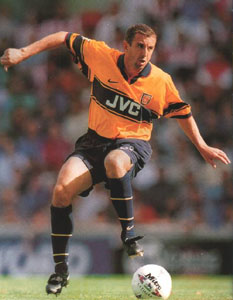
However, this defeat would only serve to spur him and the rest of the team onto greater things the following season when, having been an ever-present for the whole campaign, Winterburn would be part of one of the greatest night's in Arsenal's history - at Anfield, on May 25th 1989. Needing to beat Liverpool by 2 clear goals in order to become League Champions, Winterburn was an immense presence that night. It was his free-kick which Alan Smith nodded in for the first, and it was him, along with Dixon, who continually pushed Liverpool back with their foraging runs down the flanks.
Winterburn's determination to win was no more evident than immediately after Michael Thomas scored THAT goal - of all people it is Winterburn who immediately goes sprinting across the 6-yard box behind him to celebrate in front of the delirious Arsenal fans. Indeed, celebrating ANY Arsenal goal was something with which Winterburn became synonymous during his career in London N5. Jumping and running along the touchlines in front of the Highbury stands earned him the "Nutty Boy" nickname which remains with him to this day.
The Championship returned to Highbury in May 1991 when Winterburn, as part of the now-legendary back four (with new signing David Seaman in goal) only conceded 18 goals and lost one League match out of 38. His tenacious tackling, drive and passion was more in evidence than ever during that season, only ever really getting the better of him once at Old Trafford where, after a 20-man brawl, Arsenal were deducted two points yet still won the Championship.
Further medals followed under Graham's tutelage - he was an FA Cup and Coca-Cola (League) Cup winner in 1993, and European glory followed in May 1994, with a 1-0 win over Parma securing the Cup Winners Cup.
Sadly, the Gunners could not repeat the feat after Graham's ignominious departure the next season, and Winterburn left the Parc Des Princes in Paris with a loser's medal against Real Zaragoza. And just when there were calls for the famous back four to be broken up due to age following the brief managership of Bruce Rioch, there came a new lease of life under Arsene Wenger. With his new holistic fitness regime, Wenger managed to prolong Winterburn's career by at least 2 or 3 years, and as a result, was able to use the now-legendary defence as the foundation stone for the Double.
On the way to Double glory in 1998, Winterburn and the rest of the defence set a new club record for clean sheets whilst up-front the likes of Wright, Bergkamp, Overmars and Anelka were making headlines scoring goals. His utter determination still shone through even in the dying moments of the FA Cup Final that year when, with the game effectively won at 2-0, he made an amazing tackle to take the ball off Alan Shearer when Arsenal were under heavy pressure.
His final appearance in the red-and-white against Sheffield Wednesday in May 2000 provided a classic "passing of the torch" moment. Within minutes of Winterburn being substituted to a standing ovation at Highbury, his replacement Silvinho blasted a goal from fully 30 yards.
The time had clearly come to move on. Along with the rest of the legendary back four of Dixon, Adams and Bould, Winterburn almost single-handedly epitomised the entire Graham era with his hard work, graft and unstinting loyalty to the club, an example that many of today's highly-paid young stars would do well to emulate.